

Stranger Things Season 1: The Physics of the Upside Down
Explore portals, parallel dimensions, and what is this upside-down?
NATURE & CURIOSITYSCIENCE IN MOVIES
Neha
1/17/20263 min read
Stranger things: Even stranger physics!!
What the Upside Down teaches us about parallel worlds, flickering lights, and the fabric of reality
When Stranger Things first dropped us into the sleepy town of Hawkins, Indiana, it didn’t just serve up 80s nostalgia and supernatural chills, it quietly introduced some of the most mind-bending ideas in physics, dressed up in what initially thought as horror show. At the heart of Season 1 is a question that’s both terrifying and thrilling: what if there’s another world, just like ours, hiding in plain sight?
That for you is the Upside Down. A shadow version of Hawkins decayed and cold, but eerily familiar. It’s not just a spooky set piece.
It’s a nod to the real-world concept of parallel universes. Now, that might sound like science fiction, but here’s a way to think about it: imagine your life is a page in a book. Now imagine there are other pages; other versions of your life, stacked right next to it. You can’t see them, but they’re there. Most of the time, the pages don’t touch. But what if someone poked a hole through the paper?
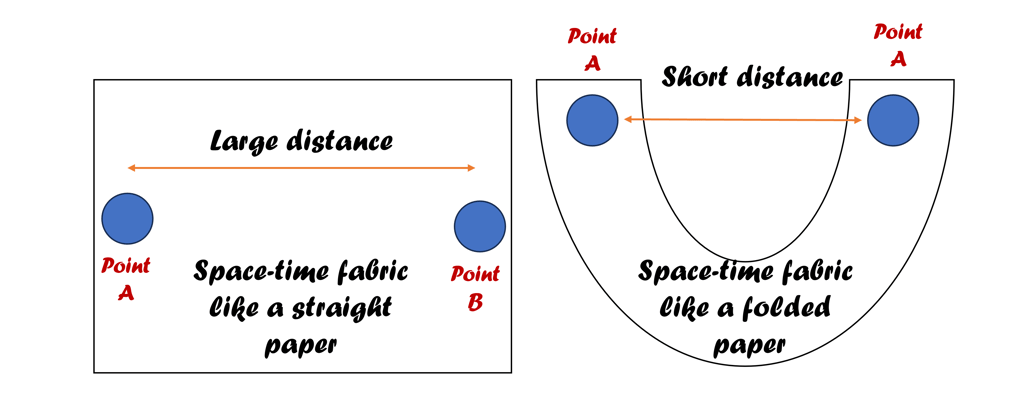
That’s what the scientists at Hawkins Lab accidentally do. They tear a hole between our world and the Upside Down: a kind of wormhole, if you like.
In theory, wormholes are tunnels through space and time, shortcuts that connect distant points in the universe.
You can think of it like folding a piece of paper so two faraway dots touch, then poking a pencil through. Voilà!!! instant shortcut. In Hawkins, that tunnel isn’t just a sci-fi idea but a mathematically proven physics concept. Isn't it mind blowing?
You must have noticed saying "space-time". What does that even mean “space and time”? Aren’t those two different things?
Here’s where it gets fun. Most of us are used to thinking in three dimensions: length, width, and height. You can walk forward and back, side to side, and jump up and down. That’s your 3D world. But there’s a fourth dimension we live in too "time". Yes, that time: the one which is never good to us. Even if you stand perfectly still, the clock keeps ticking. You’re always moving through time. So, to describe where you are in the universe, you need four things: where you are in space, and when you’re there. That’s spacetime. Think of it like a movie reel. Each frame is a snapshot of space, where the characters are, what they’re doing. But the story only makes sense when you play the frames in order. That’s time. The frames are space. The order is time. Together, they create the full experience,just like spacetime creates the universe we live in.
So, the upside down seems like parallel universe just like Hawkins but still different and its immediately below the real Hawkins because of folded space time fabric.
And then there are the lights. Oh, the lights. Joyce Byers stringing up Christmas bulbs to talk to her missing son isn’t just emotional genius; it’s also a clever nod to electromagnetic interference. That’s a fancy way of saying: when one electric thing messes with another. Ever had your speakers buzz when your phone’s about to ring? Or noticed your Wi-Fi glitch when the microwave is on? That’s electromagnetic interference in action. In Stranger Things, the Upside-Down leaks energy into our world, scrambling signals, flickering lights, and turning radios into ghostly messengers.
So no, the show doesn’t expect you to understand quantum mechanics or general relativity. It just wants you to feel it. It takes big physics ideas and wraps them in those ghostly Halloween lights, making them feel not just possible, but personal.
So, the next time your lights flicker for no reason, maybe, just maybe, it’s not faulty wiring. Maybe it’s a connection from the other side of the page.
KEEP AN EYE FOR THE NEXT SEASON EXPLAINATION