
Why the Ocean Looks Blue
Why does water look clear in a glass but turns blue colored in sea
NATURE & CURIOSITY
Neha
9/9/20262 min read
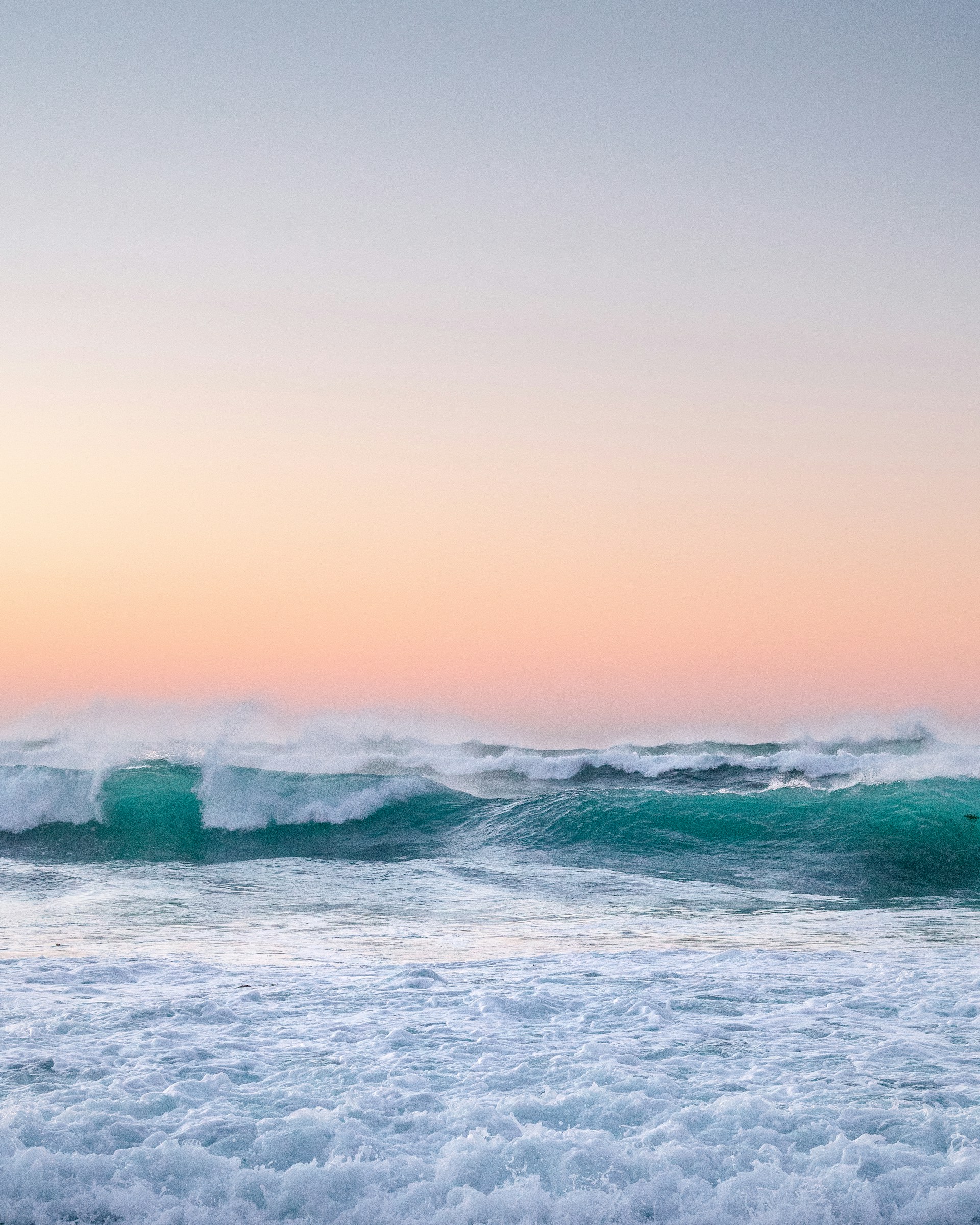
Stand by the shore, and the ocean greets you with a shimmer of blue. Sometimes turquoise, sometimes deep navy, sometimes almost gray. So, why does water look colorless transparent in a glass but turn into a vast canvas of blue when it stretches into the horizon?
Sunlight illuminates the world. It's the reason why we can see the objects around us. Every leaf, ripple, and grain of sand owes its color to this single stream of light. The sunlight seems white and sometimes golden. However, it's actually a blend of many hues, each traveling as a wave with its own rhythm and length. For example, when sunlight passes through raindrops, those waves separate into seven colors, revealing a rainbow.


What is wavelength?
Light moves in waves, just like ripples on water. The distance between two wave peaks is called a wavelength, measured nanometers (nm), one billionth of a meter.
Now the seven colors of sunlight have different wavelengths.
Short wavelengths (Colors: violet and blue) carry more energy and travel farther.
Long wavelengths (Colors: red and orange) are gentler and fade sooner.
Our eyes can see only a small slice of this spectrum, roughly 380 to 700 nm which is known as visible light.


How This Shapes the Ocean’s Color?
Water absorbs the longer wavelengths which belongs to color red, orange and yellows, almost instantly. The shorter ones, especially blue, travel deeper and scatter back.
Now what is scattering?
When sunlight enters water, it interacts with molecules and particles. These molecules and particles don’t absorb this blue color, instead, they scatter it in different directions like billiard balls. So, only blue light scatter which makes the ocean look blue/turquoise.
This means blue light travels deeper and bounces around, while red light disappears within a few meters.
In shallow waters, sunlight reaches the sandy bottom and reflects upward, mixing blue with green and yellow to create turquoise. (Need to know color theory here!!!)
In deep waters, light is swallowed before it can return, leaving behind dark navy or near‑black tones.
Additionally, there is reflection from sky which also gives it a bluish hue.
The ocean’s color is never fixed. It shifts with depth, clarity, sky reflection, and the life within it.
What you see is brilliant physics at work with nature.